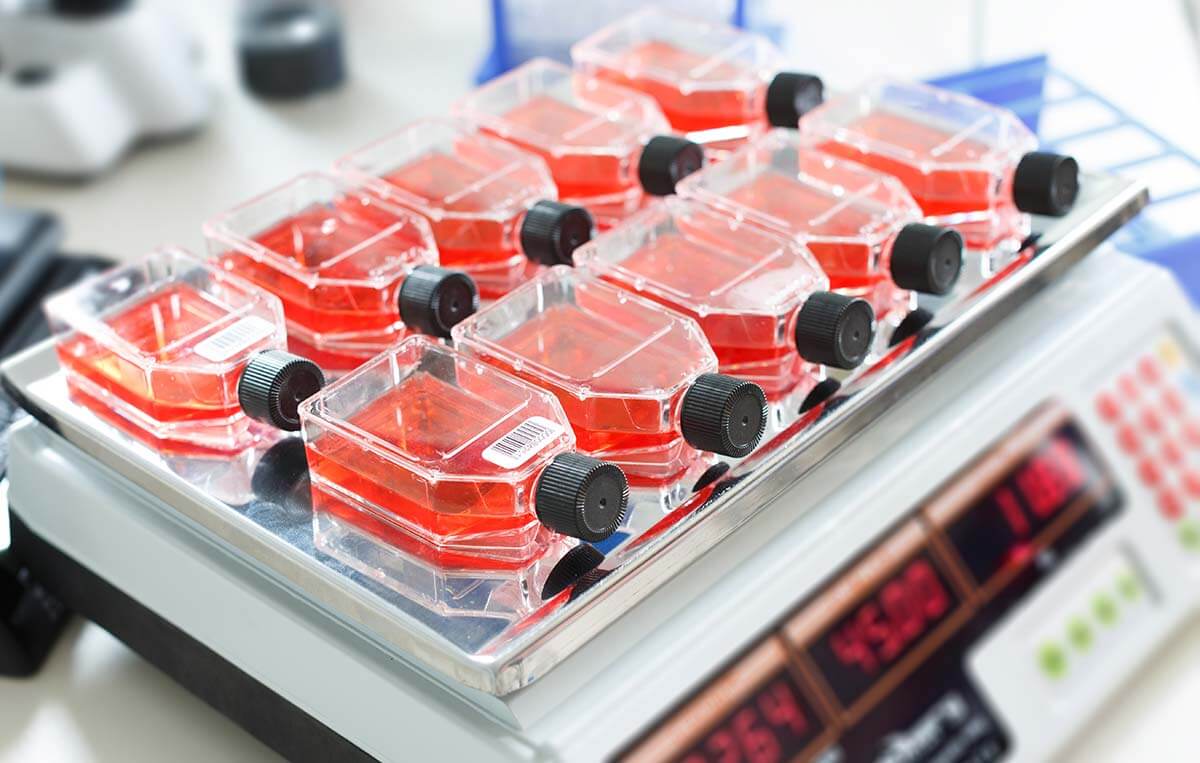
Monoclonal Antibody Production
To provide maximum antibody yield during production, SDIX examines the viability of your cell line and the clonality of your cell line. Clonality is the determination of the fraction of cells secreting antibody in a culture.
To achieve maximum antibody yield during production resulting in a lower price per milligram of antibody, each cell line is evaluated in three steps:
Recovery: We assess the viability of the hybridoma cells in the cryovial you supply to us. If the culture viability is low, we attempt to recover viability cells and establish a healthy culture. If the culture viability is acceptable at thaw, recovery work is not required and we move directly to Clonality testing. Once a healthy culture is established, the clonality of the cell line is determined.
Clonality: The fraction of cells secreting monoclonal antibody (the clonality) in a healthy culture is determined. Monoclonal antibody yield is improved when the clonality of the cell line is high. Failing to determine the clonality of the cell line prior to production may lead to unexpectedly low yields of monoclonal antibody.
Subcloning: If the clonality of the culture is acceptable, the original culture is used for production work or cell banking work. If the clonality of the culture is unacceptable, SDIX subclones the original culture by selecting the best antibody-secreting clone. This subclone is used for production or cell banking.
Ascites (In-Vivo) Production Solutions Monoclonal antibody is produced in vivo in ascites
fluid. Production in ascites fluid is nearly always the most economical
method of monoclonal antibody production; your cost per milligram of
monoclonal antibody is the lowest.
Monoclonal antibody is produced in vitro using roller
bottles. Production in roller bottles allows precise definition of the
proteins and other molecules present in the supernatant.
mAb FAQ's Solutions Q: What is the
antibody yield from ascites fluid?
A: The
yield of monoclonal antibody in ascites fluid depends on two major
factors. First, the inherent ability of the hybridoma cell line to
synthesize and secrete monoclonal antibody. This inherent monoclonal
antibody pr